







TL;DR
What a plumber charges to clear a drain in Midrand, 2026: clearing prices R500-R1,500, camera inspection, what adds cost, and the quotes to compare.
"Cost for a plumber to clear a drain" is one of the most searched plumbing questions in the node — and the honest answer is a band with a few sharp edges. The base number in 2026 Midrand: a single blockage clearing runs R500–R1,500, published across the directory. But the number that actually lands on your invoice depends on three things most searches never reach: whether the provider camera-inspects first, whether the blockage is organic or structural, and whether "clearing" quietly became "replacement" halfway through. This is the cost map — the base band, every extra that legitimately adds to it, the extras that shouldn't be there, and the two questions that keep your drain job in the clearing column. I'm Mike Fleming — 18 years in the trade, 17 in Midrand, 1,670+ jobs — and I've cleared enough drains to know exactly where the number goes when it goes up.
Written by Mike Fleming — 18 years in the plumbing trade, 17 of them working in Midrand. 1,670+ jobs completed, 21+ estate projects. Reviewed and approved by the midrandplumbers.co.za admin team · checked against the PIRB register, SANS 10400‑H and City of Johannesburg water regulations on 10 October 2026. Independently operated directory — no affiliation with listed providers.
The base number: what "clearing a drain" costs in 2026
The directory's published market estimate for a blocked drain clearing — a single blockage, standard access, the rodding or jetting that opens it — is R500–R1,500. That band covers the overwhelming majority of the calls: the slow sink, the gurgling bathroom, the garden that won't drain, the toilet that needs a second flush. The position of your job inside the band follows a simple logic:
| What the job actually is | Where it sits in the band |
|---|---|
| Simple fixture clear (toilet, basin, one tap-side block) | Bottom: ~R500–R800 |
| Standard drain line clear (kitchen/bathroom line, one blockage) | Middle: ~R800–R1,200 |
| Main line clear, or two-plus blockages, or restricted access | Top: ~R1,200–R1,500 |
| Anything structural (a broken/shifted pipe behind the block) | Outside the band — that's a repair/replacement quote, and the camera is what tells you which |
The R500–R800 bottom of the band is also where the "basic repair" pricing lives in the directory (a leaky tap, a flapper, a minor fix), which is why a provider clearing your drain and finding a small adjacent fix will quote the two as lines, not as one mystery number. The full band, with the hourly context (R400–R900 daytime) it sits inside, is in our plumbing costs in Midrand guide.
The three things that move the number up (legitimately)
1. Access. A block under paving, in a sealed pit, or behind a wall moves the job from "clear" to "clear plus access" — the opening and the making-good are real work and real cost, and a competent provider says so before the quote, not after the invoice. If your access is hard, ask the provider to price the access as its own line.
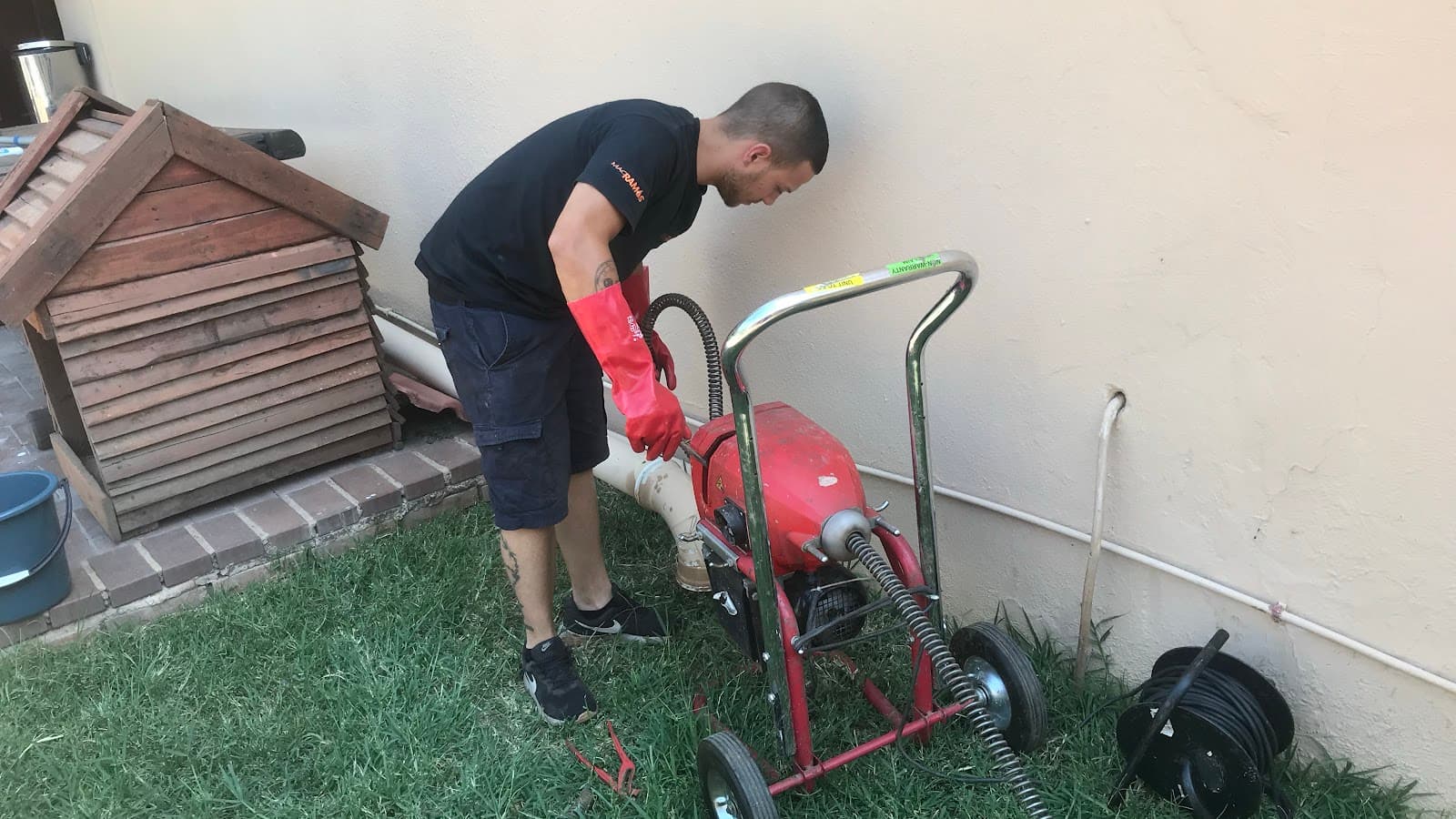
2. The method. Manual rodding opens most organic blocks at the bottom of the band; high-pressure jetting (the jetter) runs the top and is the right tool for grease-heavy lines, root intrusion, and anything that's blocked before. Jetting costs more per visit and clears more per visit — for a line that's blocked twice a year, it's usually the better money.
3. What the camera finds. This is the one people underestimate: the camera inspection is a separate, modest line (billed on its own), and it's the difference between a R1,000 clear and a R6,000 replacement. A blockage that's organic — the camera shows a fatty/root mass on an intact pipe — stays in the clearing band. A blockage that's structural — a shifted joint, a collapsed section, a root that's grown through a breach — is a repair, and the repair is priced as a scope (access, length, method), not as a clearing. The camera is the whole discipline: no replacement quote without a camera finding, and no "we'll dig and see" on a main line, ever.
The extras that shouldn't be on your invoice
From the other side of the counter, these are the lines that mean the quote wasn't a quote:
- A "travel" line on a job inside the provider's own base patch — ask which patch they cover; for the node's centre-based providers, most of Midrand is inside it.
- A clearing quoted as hourly with no ceiling — a defined-scope clear should be fixed; hourly is for genuinely open work, and even then the rate (R400–R900 day, R600–R1,300 night) should be agreed before the van moves.
- Parts "included" with no name on them — if the clear turns into a part (a valve, a coupling), the brand and the price should be named in the quote.
- A deposit for a R1,500 job — a full deposit on a small clearing is the van-disappearing risk; sensible deposits are partial and itemised, and on a clear of this size most reputable providers want nothing before the work.
The five-question discipline from the plumber near me guide — fixed or hourly, who's coming, what's included, the warranty — applies to drain work with the same force as anything else, and the drain-specific version is in our blocked drain plumber guide for Midrand, which covers the organic-versus-structural split in depth.
My drain cost case: the R900 clear that wasn't a R900 clear
A Midrand homeowner called about a slow main drain — the whole garden line backing up, the classic "it'll clear itself" situation that had now become three days. The provider's first move was the camera (a modest separate line, as it should be). The finding: a shifted joint at the property line, roots packed around it — the blockage was a breach wearing a blockage's costume. The honest quote that followed had two numbers: the clearing (the band price, which would have held for about six months) and the repair (the joint, scope-priced with the access named). The homeowner took the repair, because the camera had made the arithmetic visible: two more clearings at the top of the band, plus the root cycle restarting, versus one scoped fix. The total landed in the mid-thousands — more than the clearing, less than the second blockage plus the third. The lesson is the whole point of this guide: the camera line is the cheapest money in drain work, because it's the difference between paying the clearing price for a repair problem and paying the repair price for a repair.
How to get comparable drain-clearing quotes
The Midrand plumbers directory lists the providers with the Blocked Drains tag and their published rates — the clearing band, the call-out fees (some publish from R350), and the 24-hour marks. The comparison method is the standard one from our plumbers near me guide: filter by the tag, keep the published-rate providers, read the reviews for drain language ("cleared the main," "jetted the line," "camera showed..."), and send the drain-specific script:
"Hi — my [kitchen line / main drain / garden line] is [slow / backing up / blocked] at [suburb]. Can you confirm in writing: (1) the clearing price as a fixed quote; (2) whether a camera inspection is included or a separate line, and its price; (3) what happens to the price if the camera shows a structural fault — the repair scope; (4) who's coming and their PIRB registration number; (5) the warranty on the work? I'll decide on written quotes this week."
The reply that prices the camera, prices the structural contingency, and names the registration number has done the work — because those three lines are exactly where the drain invoices diverge. And if the camera does find the breach, the repair-side rules (named scope, staged payment, the SANS 10400‑H standard, the City of Johannesburg side of the boundary where the line meets the municipal network) are the ones the blocked drain guide covers.
The clearing band is R500–R1,500, the camera is the modest line that protects it, and the structural contingency is the number you want priced before, not after. That's the whole cost of clearing a drain in Midrand — and it's the version of the answer that keeps the invoice where the quote said it would be.
Sources & references
Further information from local authorities and relevant organisations:
- Midrand (Wikipedia)
- City of Johannesburg Metropolitan Municipality (Wikipedia)
- PIRB - Plumbing Industry Registration Board
- PIRB Public Register (verify a plumber)
- NHBRC - National Home Builders Registration Council
- IOPSA - Institute of Plumbing South Africa
- SABS - South African National Standards (SANS 10400/10256/10257)
- City of Johannesburg
- Information Regulator (POPIA)
- Consumer Protection (CPA, Act 68 of 2008)