










TL;DR
Geyser installation in Midrand, 2026: electric, solar and gas options, published prices R4,000-R15,000, the rules, and how to compare providers.
A geyser installation is the one plumbing job where the choice costs more than the work — get the type, size and spec right and the install is a day's job in a well-understood price band; get it wrong and you're paying twice, with a unit that's the wrong size for the house or the wrong fuel for the tariff. In 2026, Midrand providers publish the installation band openly — R4,000–R15,000 across electric, solar and gas — which is unusually useful, because it means you can sanity-check a quote before you book. This is the decision guide: the three types, the sizes, the real 2026 costs, and the rules that apply in Midrand. I'm Mike Fleming — 18 years in the trade, 17 in Midrand, 1,670+ jobs including 21+ estate projects where the geyser spec was the first line of the programme — and here's the guide I'd hand a homeowner choosing a new unit.
Written by Mike Fleming — 18 years in the plumbing trade, 17 of them working in Midrand. 1,670+ jobs completed, 21+ estate projects. Reviewed and approved by the midrandplumbers.co.za admin team · checked against the PIRB register, SANS 10400‑H and City of Johannesburg water regulations on 10 October 2026. Independently operated directory — no affiliation with listed providers.
The three types: electric, solar, gas
The choice is a tariff-and-usage question before it's a plumbing question:
| Type | How it works | Best for | Midrand reality |
|---|---|---|---|
| Electric (standard) | Element + thermostat, mains power | Small homes, low simultaneous use, simplest install | The default unit; the most quoted, the easiest to service — element/thermostat repairs run R3,500–R4,500 |
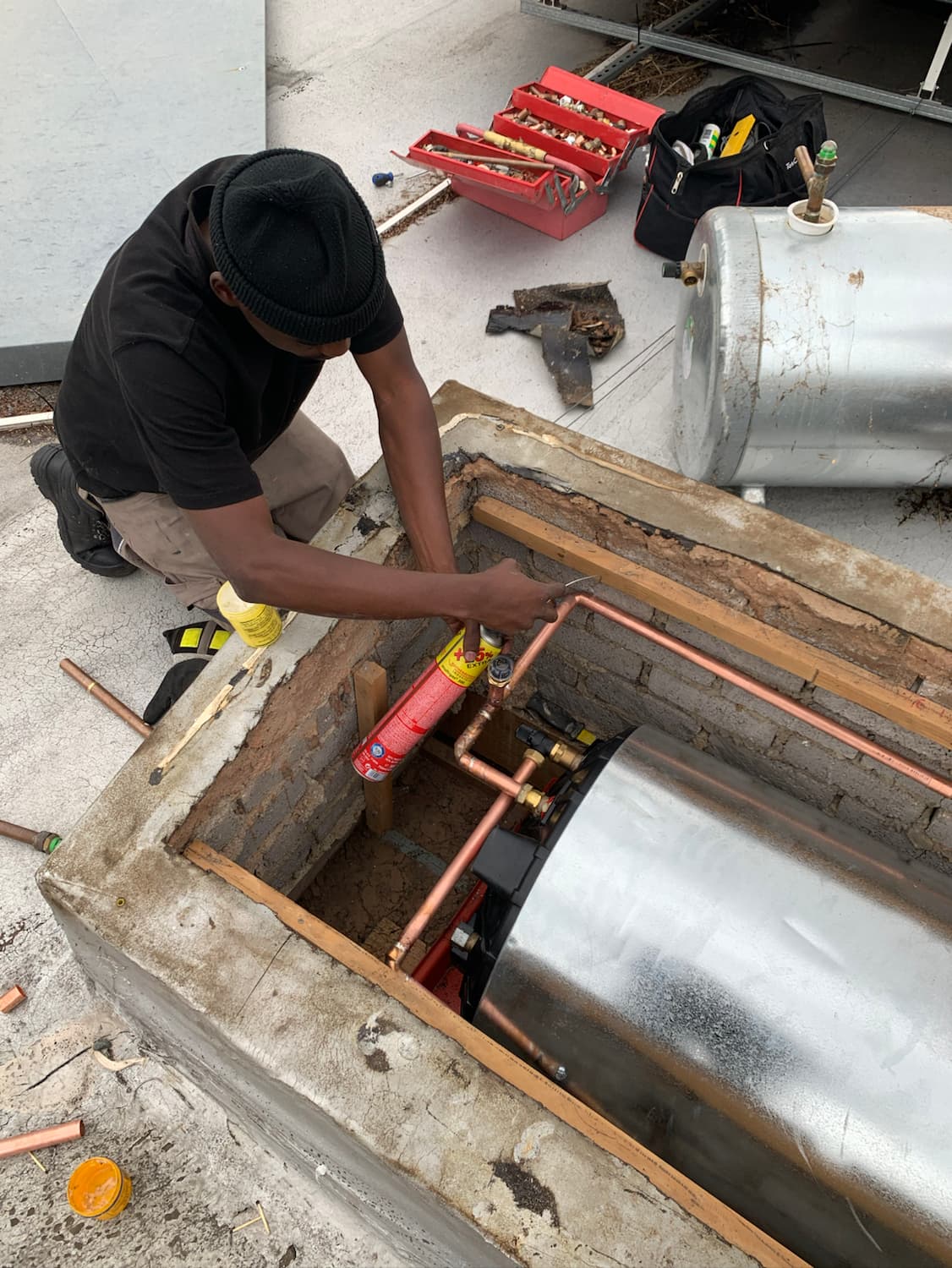
| Solar | Flat-plate manifold does the lifting, element is backup | The typical 4+ bedroom family home; load-shedding resilience | The market's default for new installs in the node; the manifold adds the solar-specific failure modes covered in our solar geyser repair guide |
| Gas | Gas-fired, fast recovery | High simultaneous demand (estate buildings, commercial) | Less common in houses; where it appears it's usually the demand profile deciding it, and it brings its own installation and certification side |
My honest position after 1,670+ jobs: for a standard Midrand family home, solar is the right default in 2026 — the manifold does most of the heating work, the element runs only as backup, and the unit keeps producing hot water through load-shedding when the neighbours' standard geysers don't. Electric is the right call for smaller footprints and simpler budgets; gas is a demand question, not a lifestyle one. The size question comes next, because a right-type geyser in the wrong size is still the wrong geyser.
Sizing: the number that decides
The standard residential units run 50L, 100L, 150L and 200L (and up, for multi-unit), and the rule of thumb that holds in the field:
- 1–2 people / one bathroom: 50–100L.
- 3–4 people / two bathrooms: 150L.
- 4+ people / two-plus bathrooms, simultaneous use: 200L — the node's workhorse, and the unit most providers quote by default for a family home.
- Townhouse complexes, small commercial: 300L+ or a commercial system — scope-priced, not band-priced.
Two sizing traps I watch homeowners fall into. Buying up on one bad evening — the R3,000 delta between a 150L and a 200L is not worth it if the household genuinely runs 150L, because the bigger unit stores more standing water and (in a solar) more heat to manage. Buying down to save — a 100L in a four-person house means the second shower waits, and "wait" is how geysers die early: the element cycles harder, the recovery can't keep up, and the repair bill arrives sooner than the saving did. When in doubt between two sizes, the provider who can tell you why the bigger one isn't needed is the provider who's doing the sizing, not the selling.
What geyser installation actually costs in Midrand (2026)
The directory's published numbers, which several local providers post openly:
| Item | 2026 price (Midrand) |
|---|---|
| Geyser installation, any fuel (provider-published band) | R4,000 – R15,000 |
| Geyser installation, labour only (standard unit) | R2,500 – R2,900 |
| Geyser replacement, unit + labour + materials | R5,000 – R15,000 |
| Solar manifold system (the solar add-on) | Inside the published install band — ask which unit/size the number carries |
| Geyser repair (element / thermostat) — the alternative to replace | R3,500 – R4,500 |
How to read that table. The R4,000–R15,000 band is unit-inclusive and fuel-variable: a standard 200L electric install sits at the bottom end; a 200L solar with manifold and roof work sits in the middle; gas and the bigger units run the top. The labour-only figure (R2,500–R2,900) is the number to ask for when you're buying the unit yourself — and it's also the number that exposes a quote that bundles a unit at a markup without saying so. The R5,000–R15,000 replacement band is the replacement decision's anchor, and it's why the repair-versus-replace conversation in our geyser repair guide starts with the named part: if the repair is R3,500–R4,500 and the replacement is R5,000+, a first failure is almost always a repair. The full cost map — and how to read any quote line by line — is in our plumbing costs in Midrand guide.
The rules: what actually has to happen
The installation side of the house is governed by three layers, and a competent provider names all three unprompted:
- The standard: the work must meet SANS 10400‑H — the national plumbing code. For a geyser that covers the installation, the relief valve, the pressure side, and the connections. A quote that never mentions the standard is a quote that's pricing the easy version of the job.
- The registration: work on your supply side should be done or certified by a PIRB-registered plumber — the register is public and the number should arrive in the first message, not the third call. For a new geyser on an existing supply, the registration matters most at the connection point; for a new supply line, it matters everywhere.
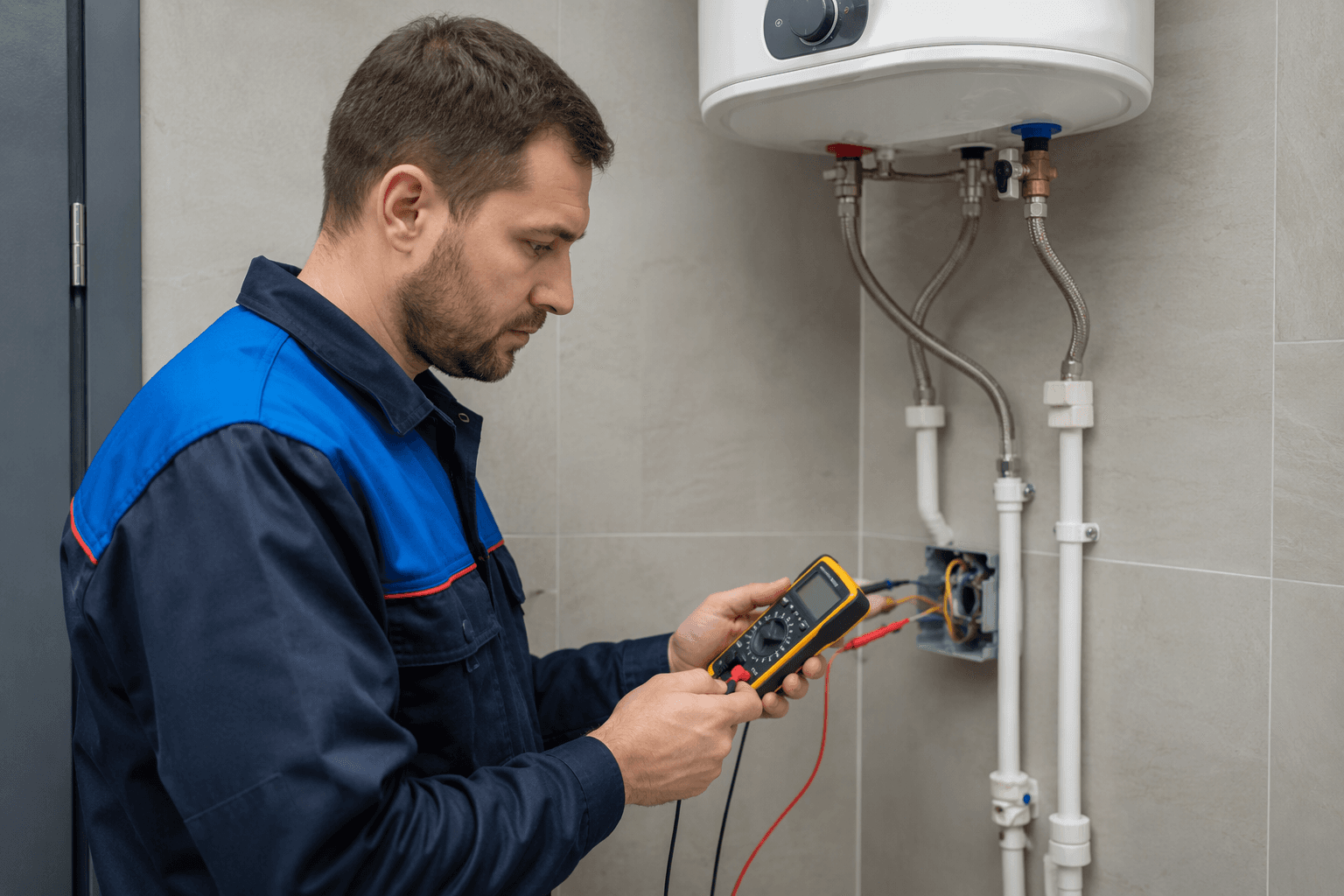
- The electrical side: the geyser's electrical connection is an electrician's job, not the plumber's — the licensed-wireman side. The clean installs I've seen are the ones where the plumber and the electrician were scheduled as one programme, not two visits. Ask the provider how they handle the electrical side; "we've got our guy" is the answer, and a named electrician is better.
- The City's layer: where the install touches the supply connection or a metered point, the City of Johannesburg rules apply — and the outage/pressure side of the system (the surge pattern that takes out manifold joints) is exactly why the relief valve and the pressure side get installed to spec, not to budget.
The four layers are why the directory's published-rate providers are the safe shortlist: a provider who posts the R4,000–R15,000 band has priced the full job, not the easy version of it.
How to compare installation providers (the script)
Several directory providers publish the installation band — the Midrand plumbers directory shows who, and the comparison method is the one from our plumbers near me guide and the plumbers near me guide. For an installation specifically, send this:
"Hi — I'm replacing/installing a geyser at [suburb]: [size]L, [electric/solar/gas], [new unit or existing supply]. Can you confirm in writing: (1) the all-in price with the unit named (brand, size); (2) what's included — manifold, relief valve, electrical connection, old-unit removal and disposal; (3) who does the electrical side; (4) PIRB registration number; (5) warranty on the work and the unit? I'll decide on written quotes this week."
The reply that names the unit, lists the exclusions, and schedules the electrician as part of the programme is the reply that wins — because the installation's hidden costs live exactly in those three lines.
The geyser is the most misquoted appliance in a South African house — and in 2026 Midrand, the published band means you can see the shape of a fair quote before you book. Choose the type by tariff, the size by household, the provider by the written scope, and the install becomes what it should be: a day's job in a known band.
Sources & references
Further information from local authorities and relevant organisations:
- Midrand (Wikipedia)
- City of Johannesburg Metropolitan Municipality (Wikipedia)
- PIRB - Plumbing Industry Registration Board
- PIRB Public Register (verify a plumber)
- NHBRC - National Home Builders Registration Council
- IOPSA - Institute of Plumbing South Africa
- SABS - South African National Standards (SANS 10400/10256/10257)
- City of Johannesburg
- Information Regulator (POPIA)
- Consumer Protection (CPA, Act 68 of 2008)